
Urge your lawmakers to oppose the 10 Percent Credit Card Interest Rate Cap Act
A 10% APR price cap on credit card interest rates would be devastating to banks’ ability to ensure the availability and affordability of credit.
What This Means In Your State
Select state to see impact
Why It Matters
If the interest rate cap is below the market-clearing rate, lenders will reduce the amount of credit extended.
Over two-thirds of the American economy is comprised of consumer spending… Rate caps do not alleviate the cost pressures that lead to high prices, they reduce credit availability and remove a key financial tool households use to manage the cost of living.
A rate cap would dramatically reduce access to credit for the very people it aims to protect, just as the economy teeters on the precipice of a recession. By significantly limiting their ability to qualify for and use credit, it would even cause many consumers to turn to predatory alternatives such as payday lenders.
According to Federal Reserve data, 37% of adults are unable to cover a $400 emergency expense with cash or its equivalent. Among those who can manage the expense, the most common solution is to use a credit card. Only 55% of adults have enough emergency savings to cover three months of expenses. For low- and moderate-income households, credit access often fills the gap when unexpected costs arise. Interest rate caps disrupt that access.
People forget that for Main Street, the business credit card is the working capital loan. A plumber or a contractor lives on that float to buy materials. If this cap goes through, issuers are going to slash credit limits overnight to protect their downside. A business owner relying on a $20,000 limit might wake up to find it cut to $5,000. It’s going to pull the rug out from under millions of small businesses that rely on that liquidity to keep the doors open.
But for most people, it will result in disruption to their personal finances, a loss of credit access, and a need to turn to other, less reputable and less convenient sources of credit. It’s a loser of an idea.
The lesson is the same whenever and wherever price caps have been used: They don’t work. So longa as sellers are competing for business, as they usually are, price controls suppress supply and make everybody worse off.
Framed as immediate relief, the interest rate cap risks producing the opposite result: reduced credit availability for those who need flexibility most, coupled with the dismantling of a rewards system that stretches household dollars across income levels.
You would have to have almost flawless credit to qualify for a 10% interest rate and that would shut a lot of consumers out of the market.
This proposal sounds a lot better than it really is. There are major unintended consequences. For example, if credit card issuers can charge a maximum of 10%, they're likely to stop lending to millions of Americans, especially those with lower incomes and lower credit scores. If their access to credit cards goes away, what are they going to turn to instead — a payday loan with a 400% APR?
Access to credit has been almost fully democratized. Everyone is using them. They are one of most popular and useful consumer products of all time.
Everything You Need to Know
In 2025, the 10 Percent Credit Card Interest Rate Cap Act was introduced in both the U.S. Senate and the U.S. House of Representatives as S. 381 by Senators Bernie Sanders (I-VT) and Josh Hawley (R-MO) and as H.R. 1944 by Representatives Alexandria Ocasio-Cortez (D-NY) and Anna Paulina Luna (R-FL), respectively.
A 10% APR price cap on credit card interest rates would be devastating to banks’ ability to ensure the availability and affordability of credit. In response, card issuers will be forced to tighten credit standards, scale back credit lines, reduce promotional offers (introductory rate offers and balance transfer offers), reduce credit card rewards, and raise costs through higher annual fees and higher monthly maintenance fees.
For consumers, many would lose their cards altogether and the short-term flexible credit they provide. For other customers who are able to keep their cards, their costs would increase while their benefits would decrease.
While all consumers will be impacted – by higher costs, reduced credit access, and fewer benefits – higher-risk borrowers with lower credit scores will bear the brunt of this misguided policy. If enacted, S. 381 and H.R. 1944, or any similar rate cap proposals, would drive consumers away from the highly regulated credit card industry. Instead, those consumers may be forced to turn to far riskier alternatives and will end up paying more for credit. As an example, the average APR for a payday loan in Missouri is 527%.
Likewise, the devastating effects of price caps have been well-documented in both Oregon and Illinois. Interest rate cap laws in those states resulted in a worsening of high-risk borrowers’ financial well-being[1] and the deterioration of the overall financial condition of households.[2] If this federal legislation advances, consumers in all 50 states would face similar financial hardship.
[1] Bolen, J. Brandon and Elliehausen, Gregory and Miller, Jr., Thomas W. (2023), “Credit For Me but Not For Thee: The Effects of the Illinois Rate Cap.” [2] Zinman, J., (2008), “Restricting Consumer Credit Access: Household Survey Evidence on Effects Around The Oregon Rate Cap.”
How a Credit Card Interest Rate Cap Will Harm Consumers
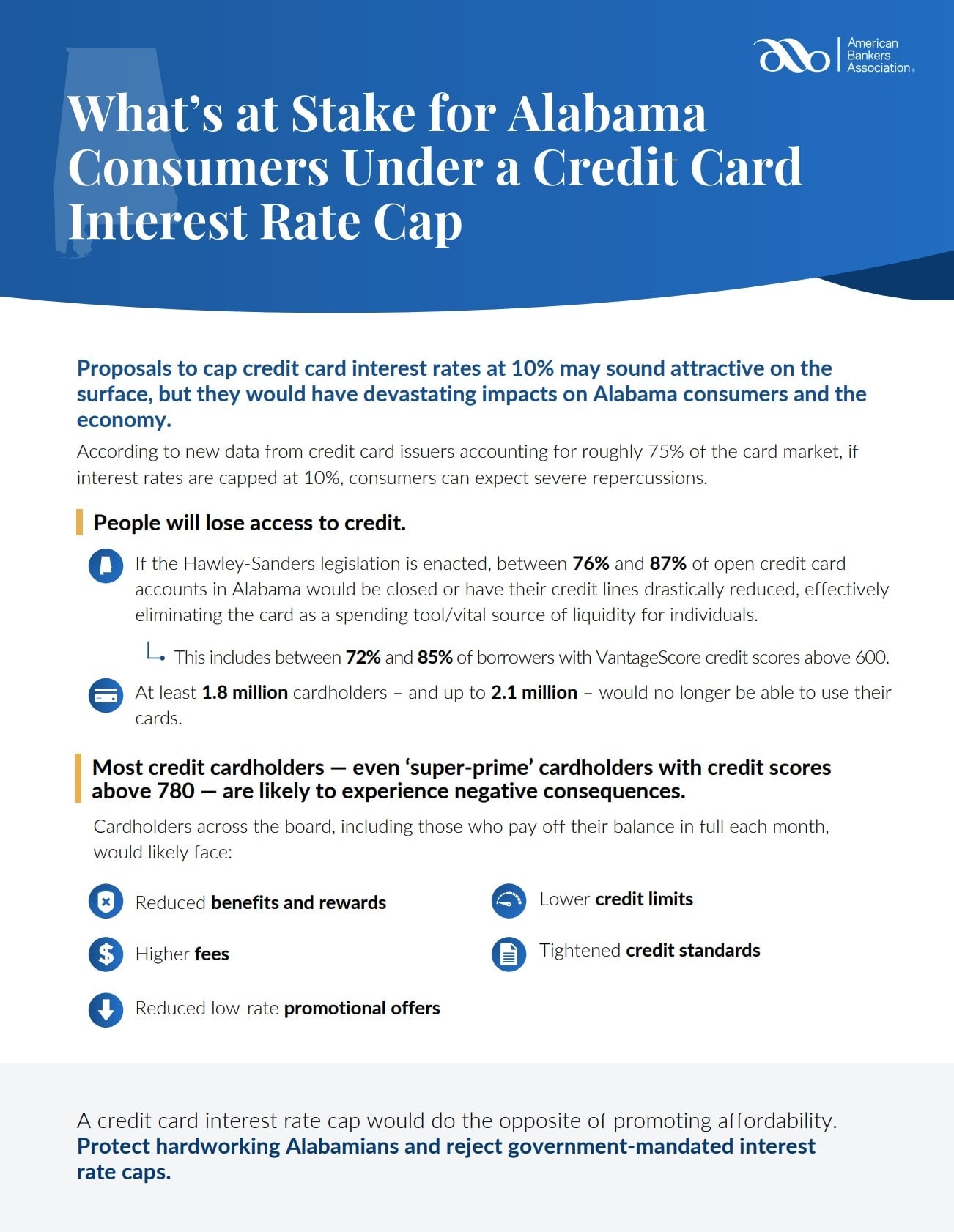
See how a 10% cap would affect credit card holders in your state below.
Stay Connected
Get updates and learn about more opportunities
Urge your lawmakers to oppose the 10 Percent Credit Card Interest Rate Cap Act
In 2025, the 10 Percent Credit Card Interest Rate Cap Act was introduced in both the U.S. Senate and the U.S.
Post the data on your social media to raise awareness.
Share on Socials: