
Urge your lawmakers to cosponsor the SCAM Act
Consumers are scammed out of an estimated $68 billion annually. Stop scams by supporting S.3774 and H.R.7548.
What This Means In Your State
Select state to see impact
Why It Matters
The SCAM Act simply asks social media companies to put consumers first by taking responsible steps to remove scammers from their platforms. Protecting Americans from fraud should be a bipartisan, national priority.
Fraud has always evolved alongside commerce. But in today’s environment… what we are seeing is different in scale, sophistication, and impact.
Developing a government-wide strategy would better position agencies to coordinate and strategically target their efforts to counter scams.
Social media creates easy access to billions of people from anywhere in the world, making a scammer’s job easier at very little cost.
Financial losses from fraud and scams are in the billions and underscore just how serious this threat has become.
While education empowers consumers to protect themselves, more is needed…to strengthen consumer protections against scams.
A safer online consumer experience is a shared responsibility… with an important role for public authorities alongside the private sector.
Nine in 10 voters support legislation requiring social media platforms to verify advertisers, remove fraudulent ads and prevent scams before they reach consumers.
Everything You Need to Know
Every day, criminals impersonate financial institutions via fake calls, texts, and emails to scam Americans out of an estimated $68 billion per year, though the true toll could be closer to $200 billion due to widespread underreporting.[1] Check fraud remains prevalent, but other payment rails are also targeted. Criminals increasingly combine psychological manipulation and social engineering with spoofed caller IDs, social media impersonation, and stolen personal information to target consumers.
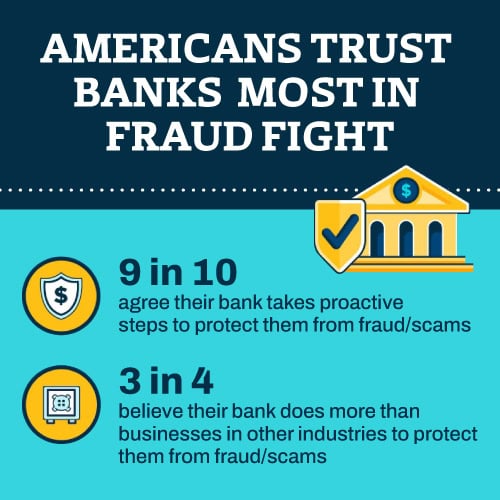
Banks are investing billions in fraud prevention tools, such as chip cards, AI-powered fraud detection systems, and multi-factor authentication, but scammers continue to adapt, posing a serious threat to consumers and the broader economy. With consumer fraud losses up more than 33% from 2023 to 2024, it’s clear that banks can’t win the fight against fraud alone.
Others are beginning to step up. In November 2025, the Justice Department launched an interagency Scam Center Strike Force to crack down on scam centers in Southeast Asia that defraud millions of Americans every year. And, in March 2026, Senators Moreno and Gallego and Representatives Meuser and Correa introduced S.3774 and H.R.7548, the Safeguarding Consumers from Advertising Misconduct (SCAM) Act, to crack down on criminals who run deceptive advertisements on social media platforms. While these are meaningful and effective steps forward in the fight against fraud, there is more that Congress, government agencies, telecommunication companies, social media, tech companies, and other stakeholders can do alongside banks to develop a national strategy to stop criminals and protect consumers.
[1] Federal Trade Commission, Older Adults Report (2025).
To win this fight, we need to treat the fraud threat like the national emergency it is. There are several meritorious proposals to combat fraud, but policymakers should prioritize the following initiatives:
- Enact the SCAM Act. Congress should pass the SCAM Act, which would require social media companies to verify advertisers’ identities, implement systems to detect fraudulent advertisements, and investigate and remove fake ads.
- National Coordination and Strategy. Establish a White House Office of Fraud and Scam Prevention and cross-agency working groups—composed of banks, regulatory and enforcement agencies, and industry stakeholders—to develop a national strategy to prevent scams and fraud.
- Regulation and Industry Accountability. Develop clear and consistent fraud-related regulations. Through FCC rules, require all telecommunications companies to block fake caller IDs and fake bank text messages and, through FTC rules, require social media companies to take down impersonation accounts.
- Coordination with Law Enforcement. Congress should establish a dedicated grant program for state and local law enforcement agencies to combat financial crimes and respond to scams. Such funding would enable jurisdictions to establish Financial Crimes Intelligence Centers. Ground-level, state and local approaches that are rooted in community relationships and operational agility are often more effective at identifying and disrupting emerging crime trends than relying solely on federal interdictions.
Fraud is a threat to all Americans, and without a “whole of government” approach that includes all stakeholders, consumers will continue to be scammed out of their hard-earned money. Congress, government agencies, telecommunication, social media, and tech companies, and their regulators have a major opportunity to partner with banks to develop and execute strategies to protect Americans by stopping fraud and strengthening scam prevention. While we work towards our goal of winning the fight against fraud, learn how to spot and stop scams by checking out BanksNeverAskThat.com and PracticeSafeChecks.com.
See Fraud’s Impact In Your State
Select your state to see the financial loss for your state and community.

Stay Connected
Get updates and learn about more opportunities

The Human Cost of $68 Billion in Fraud Losses
Real stories from bankers on the front lines of fraud prevention.