
Write your senators to ask them to protect lending in local communities by closing the payment of interest loophole
Congress has an opportunity to close the loopholes left open in the GENIUS Act.
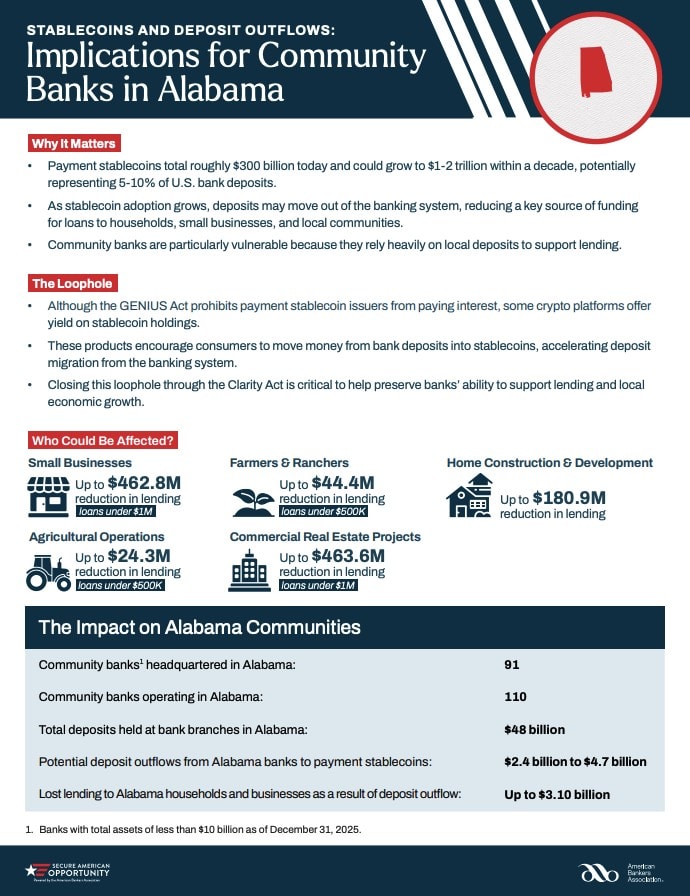
What This Means In Your State
In recent years, there has been increased interest in the United States and around the world in digital assets. Proponents believe digital assets like cryptocurrencies and stablecoins offer opportunities to improve efficiency, transaction speed, and access to financial services. At the same time, these new financial tools present new and different risks that policymakers must address. With the right rules in place, we can embrace the future without compromising financial stability.
Deposit flight from banking institutions into stablecoin holdings could shrink credit creation and lending by 25%, a direct hit to the affordability and access of consumer credit for small businesses, farms and families.
Without action, this scheme will drain money from rural communities and into the pockets of unregulated tech companies that have zero obligation to lend that money back to the people and places that need it.
Reduced lending capacity of banks means higher interest rates for businesses seeking to invest in equipment and expansion, higher borrowing costs for families purchasing homes or financing education, and less credit availability for the entrepreneurs and small business owners who drive job creation and innovation.
If Congress fails to act, it risks undermining the engine of America’s economy – small businesses.
Every day this loophole remains open, more capital flows away from communities that desperately need it.
Technology that allows consumers to bypass banks — otherwise known as disintermediation — could threaten lending to key business sectors that, in turn, could hurt economic growth and innovation.
If we don’t close this loophole, it could cause massive problems resulting in losses by retail crypto holders, a bailout of big crypto, or a financial crisis.
We believe the digital assets industry absolutely needs regulatory guardrails, and the Clarity Act can help provide those, if one short but crucial provision in the 600-page bill is strengthened.
Everything You Need to Know
Last year, Congress established the first rules of the road for digital assets. In July 2025, lawmakers passed the GENIUS Act, which created a regulatory framework for stablecoin issuers. Key aspects of the GENIUS Act include:
- Defining which entities may serve as stablecoin issuers and who will supervise them
- Establishing capital, liquidity, reserve asset diversification and other requirements for stablecoin issuers
- Prohibiting payment stablecoin issuers from paying interest or yield on payment stablecoins
Now, as the Senate considers the Digital Asset Market Clarity Act, lawmakers have an opportunity to close loopholes left open by the GENIUS Act and ensure payment stablecoins function as payment tools – not deposit-like savings products.
The GENIUS Act is a key step toward a safer digital asset market, but some companies are already looking for loopholes in the law. Despite the GENIUS Act’s clear prohibition on interest, some crypto businesses are trying to bypass the interest ban by calling payments “rewards” and routing them through crypto exchanges or other market players. This is a clear effort to skirt the law and defy Congressional intent, with real risks for the economy and financial stability.
The current text in the Senate’s Clarity Act attempts to address this issue, but Section 10404 still includes exceptions and ambiguity that could allow reward payments to mimic interest. Allowing companies to exploit this loophole would create an incentive for people to pull deposits out of their local banks, which would reduce the funds available for local lending to consumers, small businesses, and communities. This disruption in lending would ultimately slow economic activity – exactly the outcome Congress sought to avoid in the GENIUS Act. A recent Morning Consult national survey conducted for ABA found that Americans want Congress to protect these bank deposits. Key findings include:
- By a 3-to-1 margin, consumers say policymakers should bar stablecoin issuers and affiliates from offering interest and rewards if there’s a risk to lending and economic activity
- By a 6-to-1 margin, Americans say Congress and the administration should be “cautious” in establishing new rules for crypto and stablecoin and they should not take any steps that could weaken community banks or the financial system.
- 84% of consumers say companies offering bank-like services should follow the same consumer protection rules as banks
Check out the full results on consumer views on rules surrounding digital assets here.
The GENIUS Act covers only a small portion of the digital asset market, while market structure legislation still being developed sets broader rules for the entire ecosystem. Together, they create the foundation for comprehensive regulation. Congress can use the Clarity Act to close the loopholes left by the GENIUS Act by adopting the following recommendations:
- Extend restrictions on paying interest or yield on payment stablecoins to cover all market participants and strengthen Section 10404 of the CLARITY Act by eliminating exceptions that could allow interest-like rewards, thereby ensuring that payment stablecoins act as a payment tool rather than a store of value. This will minimize negative unintended consequences for the banking system and the broader economy.
Policy that safeguards consumers from risk, advances economic stability, and preserves credit access is essential. Lawmakers can protect the financial system and embrace the future by simply clarifying the rules of the road for digital assets. Congress has a chance to implement the above recommendations into the digital asset market structure legislation, addressing the loopholes left open in the GENIUS Act and strengthening the Clarity Act so payment stablecoins cannot be turned into deposit-like savings products through indirect rewards, balance-based incentives or other workarounds. With your help, we can get Congress to fix this issue while delivering the reasonable regulatory framework the digital asset marketplace needs.
Find Your State
Select your state to see how the payment of interest loophole puts local lending at risk.
Stay Connected
Get updates and learn about more opportunities
Write your senators to ask them to protect lending in local communities by closing the payment of interest loophole
Congress has an opportunity to close the loopholes left open in the GENIUS Act.
Post the data on your social media to raise awareness.